(This article was produced for the 2025 KCCA Art Writing Workshop. )
If you have graph paper at hand, or imagine one, pick up a pen and draw a casual arc, preferably with some width. Some squares are filled by the brush, while others are only partially covered with color. Do the half-filled squares count as colored or uncolored? The blocks on graph paper, like the pixel array of a screen, can hardly fully capture the free, real brushstrokes. Especially lines with uneven ink, and the fractured texture caused by friction and scratching, the uniform squares on screen struggle to interpret intermittent brushwork.
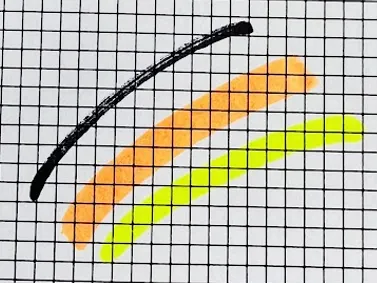
The “Snake” series draws inspiration from early handheld “Snake” games, where Yu Chih-Han realized how the snake’s flexible body was constrained by digital blocks. The biological form and smooth movement were limited by the aesthetic symbol of “stuttering,” transforming the long snake into a straight bar, advancing with jerky steps (Figure 2).
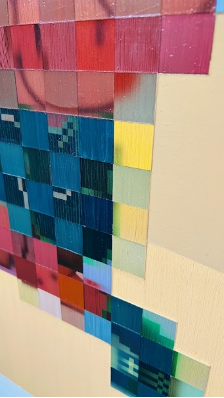
Using masking tape to mark out grid territories, Yu Chih-Han thickly applied acrylic paint within the squares. The thick application of paint creates a sense of weight, generating kinetic energy in the color blocks; the almost overflowing surface of the paint, like the rim of a cup filled with liquid, seems on the verge of spilling. The artist utilizes acrylic to unleash the potential of painter’s brushwork, yet the desire for fluidity is confined within defined squares. From a distance, Yu Chih-Han’s paintings appear as neat as a digital screen, but up close, one feels the impactful force between the color blocks. At first glance, Yu Chih-Han’s painting method mimics a screen composed of clusters of minimal light points, the smallest unit forming the image, but in deed each tiny color block on the canvas still retains the life of brushstrokes.
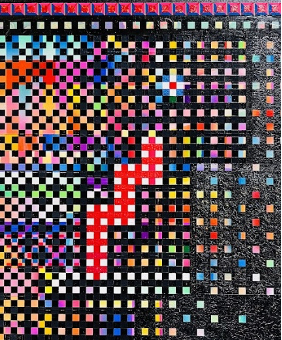
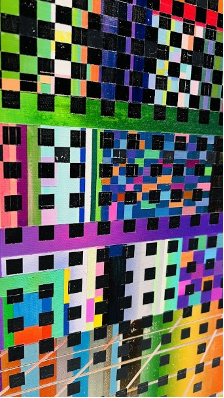
Beyond the physical properties of paint, the vitality of the painting also comes from the arrangement and composition of the color blocks. “Pixel.02” (Figure 3) features brightly colored squares that simulate the luminous pixels on a screen, with its green, red, and yellow blocks neatly arranged into a regular grid. If we pretend that there are dashed lines marking the boundaries of these colored squares. The black squares Yu Chih-Han places in the image awkwardly traverse these boundary lines. Sometimes the exact center of a black square overlaps with the intersection of dashed lines, while at other times, one side of a black square adheres tightly to a dashed line. Digital screens lack the ability to render these black blocks because they cannot be fully contained within the grid, just as graph paper cannot precisely capture our casually drawn colored strokes.
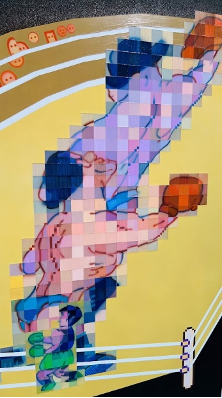
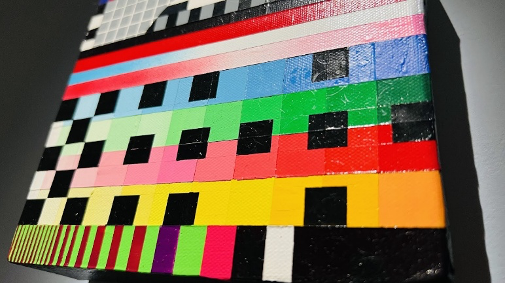
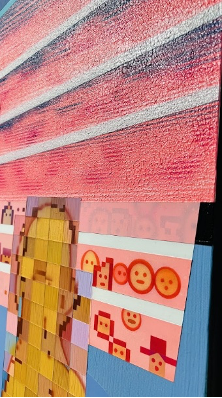
The black squares in “Level.01” (Figure 4) provide a contrasting function; these black blocks are neatly arranged, helping the viewer visually define the grid boundaries. What breaks this boundary are elongated cross-grid color blocks, gradient color blocks that a single pixel cannot render, and diagonally perspectival rhomboid stripes. “Round 3” (Figure 5) subverts screen through interfaces with differing textures: the neat planar surface created by a brush and the wrinkled skin printed by a roller, along with varying paint thicknesses, challenge the uniform, fully illuminated surface of a digital screen. Sometimes, outlines appear within the color blocks, such as the head of a boxer, with areas above and below the lines filled with different colors, also exceeding the expressive capability of a single pixel.
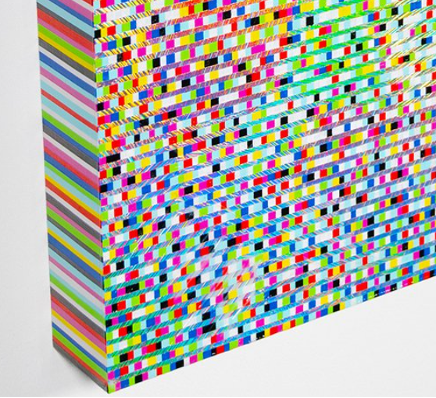
The digital color blocks remind me of artist Justin Armstrong from the Savannah College of Art and Design, who is deeply influenced by the visual style of 90s Game Boys, CRT screens, and Pokémon holographic cards. He uses tape to mask off neat strip patterns, applies acrylic paint, and upon removing the tape, reveals the covered holographic vinyl — a plastic that shimmers with different hues depending on the viewing angle (Figure 6). Justin Armstrong mixes the texture of acrylic with the luster of holographic vinyl to create a sensory experience of simultaneously viewing a Polaroid photo and a glitching screen. This “digital screen/painting” comparative action is precisely what Yu Chih-Han’s work explores: the contrasting relationship between paint texture and digital imagery.
Furthermore, both artists’ works require the audience to be present. Justin Armstrong emphasizes the necessity of on-site viewing since screens cannot convey the dynamic light and shadow shifts of holographic vinyl on site. Similarly, the sensory experience in Yu Chih-Han’s work is not easily transferred by a screen; you must be present to appreciate the artist’s intention in manipulating the paint, the thickness and stillness of the painting, and how the visual experience of a digital screen is solidified into a material entity.
Although both artists share similar visual approaches, I want to specifically point out that Yu Chih-Han does not merely recreate the painting plane to explore the contrast between paint and screen; the bodily sensations generated during the creative process also reproduce the non-visual differences between digital screen and painting.
Yu Chih-Han first uses digital software to create compositional drafts, defining the elements and grid arrangement of the image. After grasping the general layout, she applies masking tape according to the planned grid and fills the corresponding squares with acrylic paint. Here, two aspects can be identified: first, the temporality of image generation, and second, the fluidity of the smallest unit.
Digital screens have a refresh rate, which is the number of frames they can display per second. Contemporary technology achieves at least 60Hz, meaning one frame can be displayed every sixtieth of a second. Consider how much time it takes for an artist to paint a small square on a canvas with a brush, and how long it takes to complete the entire painting. This illustrates the temporal difference in image generation between painting and digital screens. We are accustomed to viewing artworks on screens, where paintings constantly appear and disappear with a swipe of a finger. Digital screens not only replace the physical texture of paint but also make people forget the bodily movements required during the painting process and the changes in every moment of the artist’s movement.
Continuing to the second point, the fluidity of the smallest unit, let’s narrow our gaze from the entire painting to a single square on the canvas. Drawing a square by hand is far more complex than a single pixel on a screen receiving a signal and emitting a pre-set spectrum of colored light. For a square, decisions about hue, brushing, and the force applied are all related to the artist’s state at that moment. In the “Punch Out!!” series, because the boxer’s silhouette crosses different squares, a single square must accommodate different color blocks and patch corresponding outlines based on neighboring images. Taking “Round 6” (Figure 7) as an example, the boxer’s shoelace appears in a single square. The artist cannot simply flat-fill a complete color like a screen pixel but must decide how to paint the shoelace. Here, Yu Chih-Han chooses to pixelate the shoelace again, maintaining consistency in the painting’s style. In addition, the outline of the boxer’s elbow crosses four squares, which is also a complex pattern that a single screen pixel cannot handle, requiring consideration of the logic of elbow shape, and how it connects to the neighbor squares. The artist must actively interpreting the painting within the hypothetical smallest unit of the image, unlike passive and uniform pixels on a screen.
“Hyperbolic Time Chamber: Yu Chih-Han’s Solo Exhibition” carries a strong digital nostalgia, pulling the audience back into the digital world of the 90s. Game scenes constructed from high-saturation color blocks and humorous boxer poses immediately capture the viewer’s attention. What I appreciate even more is the artist’s extremely subtle planar experimentation, underlying the strong game style and pixel aesthetic. The kinetic energy generated by the layered acrylic resists the constraints of pixel squares. Misplaced, gradient, and obliquely projected color blocks break the limitations of screen rendering. The bodily actions during the creative process imply a refresh rate different between a painting surface and a digital screen. The painter’s choices push against the restrictive framework of single pixels. Visual differences, physicality, sense of time, and the presence of the painter — Yu Chih-Han’s work offers us a new perspective on digital screens, orchestrating multiple concepts to approach.