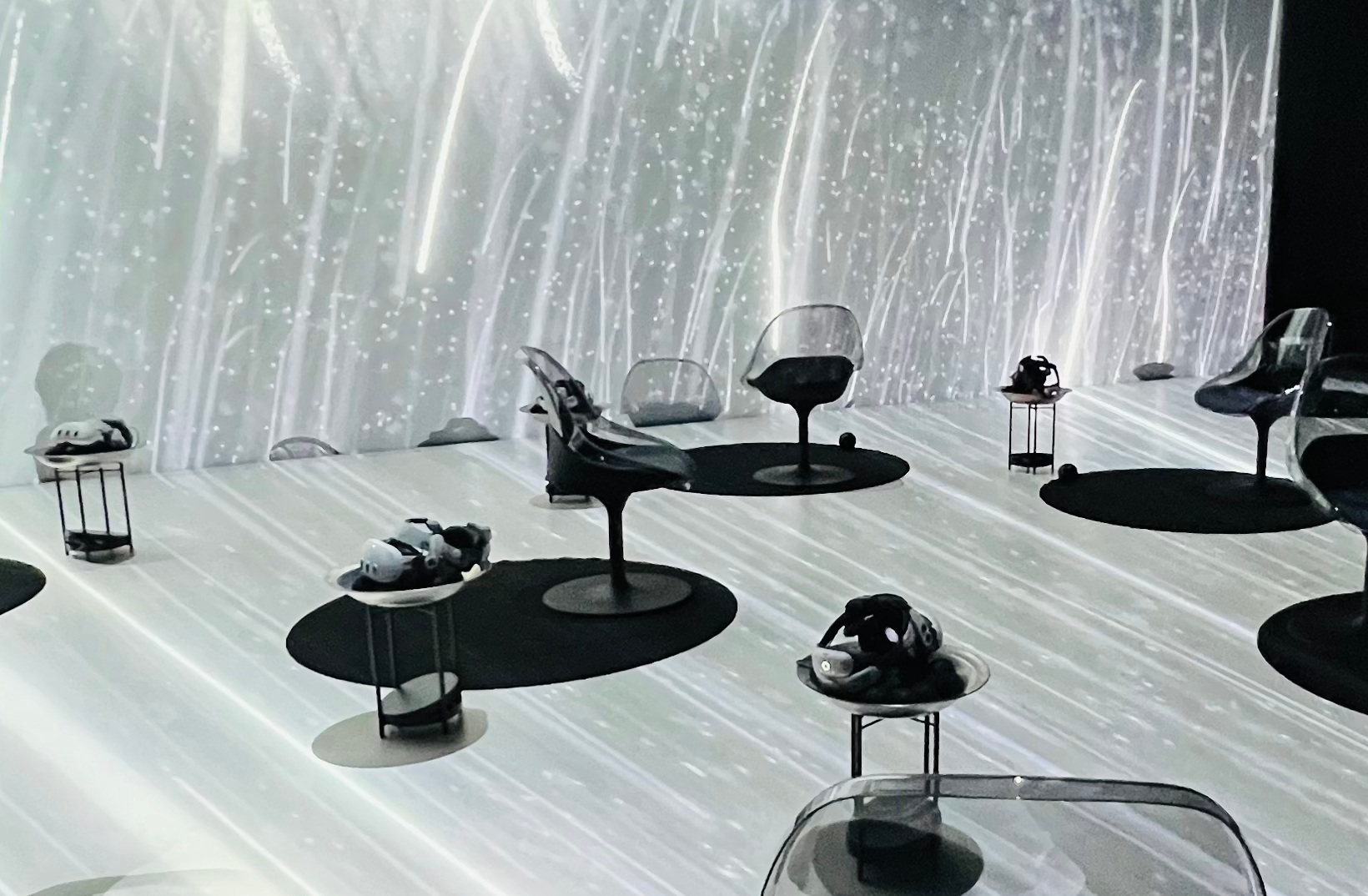
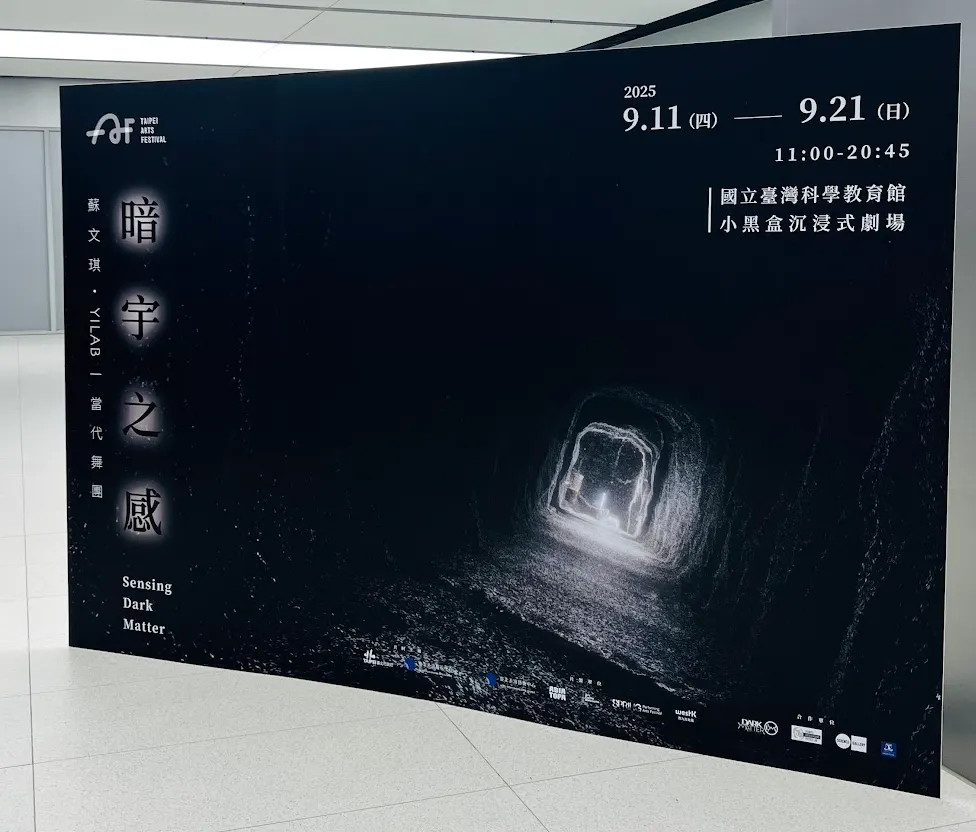
When an artwork promises to sense the insensible, it engages in a profound semantic struggle. Dark matter haunts the universe through its refusal to appear, a ghost in physics detectable only by its gravitational footprint yet silent to the visible spectrum. My approach to Su Wen-Chi 蘇文琪 and YILAB’s Sensing Dark Matter 暗宇之感 was therefore charged with a specific anticipation. I did not expect a literal scientific visualization, nor did I await a mystical seance. Rather, I anticipated a rupture , a disconnection from mundane sensory reality that would prepare me to explore a new regime of perception. Yet, as I emerged from the experience — a duality of dance video and VR journey — I was left suspended in a lingering ambiguity. Had I truly developed a new cognitive framework for the cosmos, or had I merely traversed a constructed, aesthetically pleasing void? The answer, I realized, lay not in the artists’ intentional cues, but in an inadvertent choreography of my own body, triggered by the very absence of sensation.
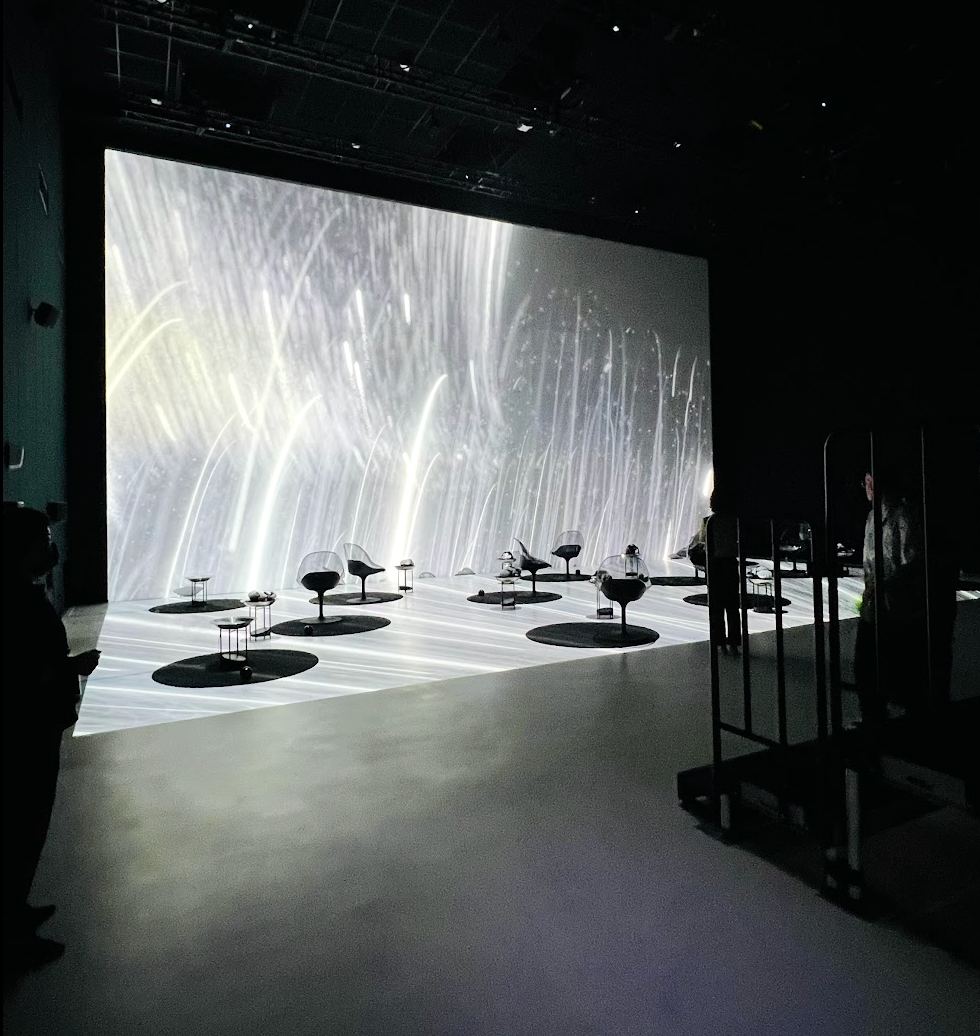
The inquiry begins with the dance video, situated within the stark, subterranean Stawell Underground Physics Laboratory in Australia. We witness dancer Tien Hsiao-Tzu 田孝慈, clad in Klein Blue, navigating a high-tech cavern of aggressive whiteness. She moves amidst a constellation of scientific apparatuses. As the camera captures her tactile interactions with the walls, meters, and conduits, I was instinctively anchored in a terrestrial experience. I projected my own memories of lab rooms — or cinematic depictions of laboratories familiar to a general audience — onto the video, grounding the perception in the tangible machinery rather than the cosmic unknown.
This reliance on environmental feedback is not merely a viewer’s projection but a stated methodology. In interviews regarding this work1, Su Wen-Chi described the team’s process as an improvisational exploration of the cave’s humidity, temperature, and acoustics. Team member Hsieh Wen-Yi 謝文毅 used 3D scanners to reconstruct the tunnels and lab spaces, while Wu Ping-Sheng 吳秉聖 captured the shape of the sound fields. Dancer Tien Hsiao-Tzu similarly noted that the rock walls, high-ceilinged space, and atmospheric shifts triggered her intuitive response. This approach extends into the work’s second component, the VR, which Su describes as a technological reconstruction allowing the audience to “enter” the cave and the colossal detector. Consequently, as we fly through the chandelier-like structure of the recreated detector in VR, we gain a deeper understanding of the facility, yet dark matter remains hidden in an inaccessible elsewhere. Narrative and visual cues highlight site attributes like humidity and infrastructure. However, these are man-made or geological conditions, not emanations of dark matter. Thus, the work appears to be capturing the features of the laboratory, rather than an encounter with dark matter itself.
To navigate this skepticism, I turn to the theoretical framework of Karen Barad’s Agential Realism2. Challenging the classical view of measurement as recording pre-existing facts, Barad draws on quantum mechanics3 to argue that reality emerges only at the moment of an “agential cut.4” Before this cut, there are no fixed boundaries — not even between the measurer and the measured; it is only after the agential cut that a specific reality is determined. Measurement is therefore not an idle recording of independent facts but an active participation in their generation. Viewing the work through this lens, the dancer needs not compete with scientific indexicality5 because her dance, as a unique agential cut, is the measurement event itself. The question shifts from “Is there a direct link to the object?” to “What is the specificity of this agential cut?” Even if Tien’s somatic feedback is triggered by the laboratory’s humidity and the hum of machinery, these are the particular facts around this specific agential cut. Her body — flesh, sweat, and proprioception — entangled with these conditioning elements, collapses the possibilities of the dark matter into a singular, determinate measurement.
However, a sharp dissonance arises when the potential richness of this dance was translated into the visual representation. Whether in the video’s post-production or the subsequent VR experience, the visual language retreats into swarms of drifting white light points. Here lies the work’s most significant aesthetic limitation. Rendering the unknown into particles activates the audience’s pre-existing cognitive anchors from basic physics education that we see the world as composed of electrons, protons, photons, etc. While dark matter research indeed leans toward particle physics, this artistic choice semantically narrows the subject. It reduces the profound mystery of dark matter into a generic variable, a vacant signifier, or a placeholder. These particles become empty containers: they signify science in a general sense but fail to carry the specific weight, tension, and entanglement of the dancer’s unique labor in the underground lab. The visual cleanliness of the VR particles sanitizes the messy reality of the agential cut I had just theoretically validated. I found myself recognizing the image of physics, but not acquiring a new imagination for the dark matter itself.
This visual flattening brings me to the core of the medium: Virtual Reality. My expectation for VR in this context was rooted in its potential as a somatic bridge. Since I cannot physically inhabit the dancer’s body or visit the Australian underground, I expected VR — functioning as a trans-corporeal medium — to manipulate my senses to approximate the tension, gravity, and resistance Tien experienced. I expected the technology to translate the fleshiness of the dancer into a tangible sensation for the seated viewer. Intuitively, VR appears to deprive the user of somatic grounding, operating primarily through the visual. However, it is here, in the gap between the dominance of the visual and the absence of physical feedback, that I identified a distinct phenomenon, one that likely exists independently of the work’s narrative intent. In fact, I argue that this very characteristic of VR holds the potential to become the medium-specific quality essential for exploring dark matter.
Scientific literature on “pseudo-haptics” offers a lens to understand this quality. Samad et al. (2019) demonstrated that discrepancies between virtual lift height and physical movement directly alter perceived weight, revealing that the human brain estimates an object’s weight by roughly 82% proprioceptive input and 18% visual cues during lifting tasks6. While this ratio varies by task7, VR fundamentally exploits it.
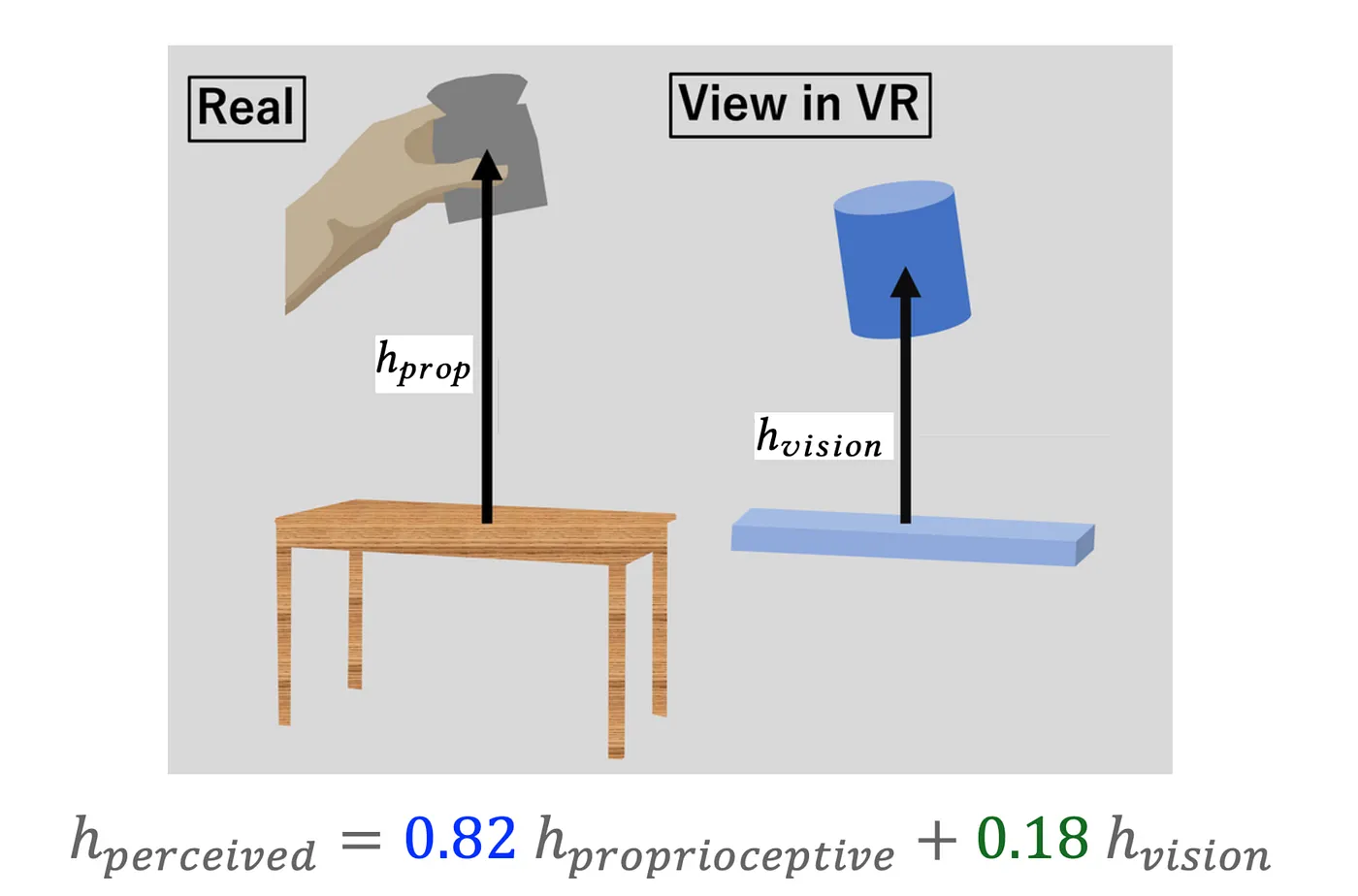
Given the impossibility of fully inhabiting another’s body, I propose a shift in perspective. Rather than framing VR as sensory deprivation, I suggest it functions as a mechanism that amplifies visual cues to recalibrate experience. For instance, think about how visual manipulation alone can induce the visceral distress of a mobility-impaired person who falls. Furthermore, I argue that this forfeiture of proprioception can be utilized to choreograph the audience, prompting them to actively enact a physical response to compensate for the missing somatic input.
I experienced this compelled self-choreography during a specific sequence in the VR journey. As the swarms of drifting white light points coalesced into long, streaming trajectories, forming a massive, swirling vortex that rushed toward me, my body reacted, following a naturalistic, gravitational logic. Though seated in a stationary chair, I felt an undeniable urge to tilt. Heels dragged on the floor to generate sensory friction. Body twisted to align with the visual flow. Muscles tensed against a phantom force — a reaction, in reality, to the actual gravitational pull induced by my own leaning. That was a “star-flight” experience transcended the visuality of the dots. The VR system did not provide the physical inputs of motion, yet upon receiving the visual flow, I found myself needing to perform the missing physics. This is what I identify as a choreography from absence. The VR medium conditioned my environment to force a somatic response.
This brings me to a final reflection on Sensing Dark Matter. On one hand, the visual choice of white dots remained tethered to the generic, failing to offer a new lexicon for the unknown. On the other hand, my experience of the VR revealed a structural resonance that perhaps exceeds the work’s conscious design. Dark matter is defined by its absence from our sensory spectrum; it pervades the universe, yet we only know it through its gravitational effects. In the VR chair, with my heels dragging against the floor to resist a phantom current, I was enacting a parallel existence and reacting to a force that was physically absent, mediated by a technology that relies on sensory gaps to function. I sensed something, not because the artwork made it visible, but because the void of the medium, or the conditioned conditions, activated my body to fill the gap. This medium specificity of VR — utilizing the absence of somatic input to provoke active engagement and a unique form of self-choreography — precisely mirrors how dark matter, despite its imperceptibility, elicited a response from the dancer in the deep underground. The structural nature of the VR echoes the very essence of dark matter.
-
Tsai, S. (2025, July 31). 地底一公里,一趟重建感官的探險之旅. 臺北藝術節. https://tpac.org.taipei/festival-taipei/2025/posts/470 (Accessed December 12, 2025) ↩︎
-
Barad, K. (2007). Meeting the universe halfway: Quantum physics and the entanglement of matter and meaning. Duke University Press. ↩︎
-
This refers to the Copenhagen interpretation of quantum mechanics, where an object exists in a superposition of all possible states until measured by an observer or instrument. This interaction forces the object to “collapse” into a determinate state. ↩︎
-
An agential cut is a boundary-making practice that enacts a resolution of inherent ontological indeterminacy within a phenomenon, delineating “object” from “measuring agency” to make objectivity possible. (Barad, 2007, p. 175) ↩︎
-
Scientific authority often rests on what Bruno Latour calls a ‘chain of reference’ or Peirce’s concept of indexicality — the assumption that an instrument provides an objective, causal trace of the phenomenon. In this view, a sensor reading is a ‘fact,’ while a dancer’s movement is merely an ‘interpretation.’ ↩︎
-
Samad, M., Gatti, E., Hermes, A., Benko, H., & Parise, C. (2019, May). Pseudo-haptic weight: Changing the perceived weight of virtual objects by manipulating control-display ratio. In Proceedings of the 2019 CHI Conference on Human Factors in Computing Systems (pp. 1–13). ↩︎
-
Similarly, Bergström et al. (2019) influenced size estimation by adjusting the grasping aperture, while Bouzbib et al. (2023) manipulated the degree of visual compression to alter the perception of stiffness. ↩︎